
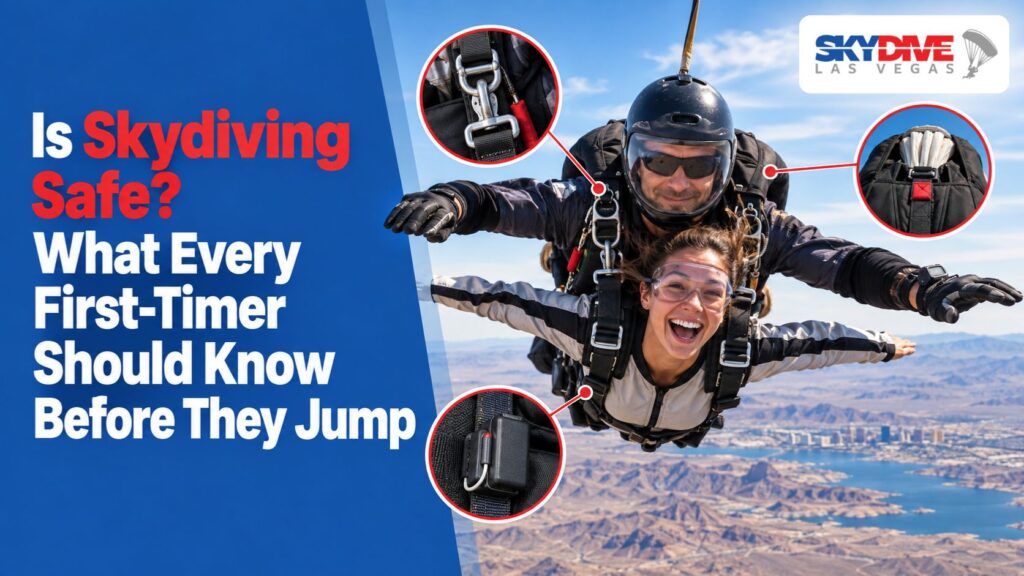
So, is skydiving safe? For a first-time tandem jump with a certified instructor, the honest answer is yes, it’s far safer than most people assume. In 2025, U.S. skydivers made about 3.47 million jumps with a fatality rate of roughly 0.46 per 100,000 jumps, and tandem skydiving (where you’re harnessed to a trained professional) is statistically the safest way to experience it.
That doesn’t mean the risk is zero. Skydiving is an extreme sport, and pretending otherwise would be dishonest. But understanding where the real risks come from and where they don’t is the best way to walk to the plane feeling informed instead of anxious.
How Safe Is Skydiving, Really?
Let’s start with the data, because feelings about heights and actual risk are two very different things.
According to the United States Parachute Association (USPA), members made roughly 3.47 million jumps in 2025, resulting in 16 fatalities nationwide. That works out to about 0.46 deaths per 100,000 jumps. Injuries serious enough to need medical treatment were reported by 5.6% of members that year, and the most common one wasn’t dramatic at all. It was a sprained or twisted ankle on landing.
To put that in perspective, here’s how skydiving compares to everyday activities people rarely think twice about.
Activity | Approximate risk level | Notes |
Driving a car | Higher annual risk | Most people accept this daily without hesitation |
Skydiving (all jumps) | ~0.46 deaths per 100,000 jumps (2025) | Includes experienced sport jumpers pushing limits |
Tandem skydiving | Lower than the all-jumps average | First-timer is attached to a trained professional |
In short, the overall fatality rate is low, and tandem jumping, which you’ll do as a beginner, carries even less risk than the all-jumps average because a professional is in control.
Why Most People Overestimate the Danger
The fear usually isn’t about the statistics. It’s about the idea of jumping out of a plane.
Here’s the part that surprises people: most skydiving accidents are not caused by parachutes failing. They’re caused by human error and most often by experienced jumpers making a judgment mistake while landing a perfectly working canopy. Think of it like car crashes. They’re rarely caused by the engine exploding; they’re caused by driver decisions.
For a first-timer, that’s reassuring news. You’re not the one making split-second flying decisions. Your instructor is.
What Makes Tandem Skydiving the Safest Way to Start
When you book a first-time jump, you’re doing a tandem skydive securely harnessed to a certified instructor who controls the exit, freefall, parachute deployment, and landing. You don’t need any prior experience, and you’re never managing the technical side alone.
A few things work in your favor:
- A pro is flying. Your instructor has typically completed hundreds or thousands of jumps and is rated to handle everything from gear checks to weather calls.
- Redundant equipment. Every system includes a main parachute and a reserve parachute, plus an automatic activation device (AAD), an electronic backup that deploys the reserve on its own if the main parachute isn’t opened in time.
- A thorough briefing. Before you board, you’ll get a ground briefing covering body position, the harness, and what to expect, with time to ask questions.
In short, Tandem skydiving removes nearly all the decision-making from the beginner and puts it in trained hands, backed by layered safety equipment.
How Often Do Parachutes Actually Fail?
Rarely, and even when something goes wrong, there’s a plan for it.
In 2025, USPA members reported using their reserve parachute at an estimated rate of about 1 reserve use per 726 jumps. Notice that a “reserve ride” isn’t a disaster; it’s the backup system working exactly as designed. Modern parachutes are tested well beyond the stresses of a normal jump, and student rigs always include that automatic activation device as an extra layer.
So the realistic question isn’t “what if the parachute fails?” It’s “what’s the backup if the main doesn’t open?” and the answer is a second parachute plus an automatic trigger.
Can You Skydive If You’re Scared of Heights?
Yes, and plenty of nervous first-timers do exactly that.
Here’s why it works for many people: at jump altitude, you’re so far from the ground that your brain doesn’t process it the way it processes standing on a tall ledge. Most jumpers describe the sensation as floating or flying rather than the stomach-drop feeling you get on a roller coaster. The fear of heights is usually tied to a visible edge, and there isn’t one at 13,000 feet.
That said, if anxiety is severe, talk to the staff beforehand. A good drop zone wants you informed and comfortable, not pressured.
When Skydiving Might Not Be Right for You
Honesty matters more than a sale here. Skydiving isn’t the right call for everyone on a given day, and a responsible operator will tell you so.
You may want to reconsider or check first if you:
- Have certain heart conditions, have had recent surgeries, or are pregnant; check with a doctor first.
- Exceed the weight limits set for tandem equipment (these exist for safety reasons).
- Have had alcohol or are not feeling clear-headed that day.
- Being pushed into it and not actually wanting to go, that’s okay, too.
If conditions like high winds roll in, expect your jump to be delayed or rescheduled. A drop zone that postpones for weather is showing you good judgment, not bad luck.
What to Look for in a Safe Skydiving Operation
Not all the safety reassurance is on you to verify, but a few green flags are worth knowing before you book anywhere, including for those searching for skydiving near Las Vegas.
- USPA-affiliated instructors and standards. This signals adherence to established training and equipment protocols.
- Certified gear and regular inspections. Parachutes should be packed and maintained to professional standards.
- A real safety briefing. You should never feel rushed onto the plane without understanding the basics.
- Transparent communication. Good staff members answer your questions plainly instead of brushing them off.
At Skydive Las Vegas, first-timers get a full ground briefing, jump with experienced instructors, and have the desert and mountain views of Nevada as the backdrop, but the same checklist applies wherever you choose to jump.
Frequently Asked Questions
Yes. It's the safest entry point into the sport because you're attached to a certified instructor who manages the entire jump, supported by redundant parachute systems.
Based on 2025 USPA data, the rate was about 0.46 fatalities per 100,000 jumps across all skydivers, including experienced jumpers. Tandem jumps with a professional carry lower risk than the average.
No. Reserve parachutes were used at roughly 1 per 726 jumps in 2025, and a reserve deployment means the backup system worked as intended. Every rig also carries an automatic activation device.
Minor landing injuries, most often to the ankle, are the most commonly reported, far more common than serious accidents.
Often, yes. Many people with a fear of heights jump comfortably because free-fall doesn't trigger the same edge-related fear. Share your concerns with the staff beforehand.
Tandem jumps are typically made from around 10,000 to 13,000 feet, giving you roughly a minute of free-fall before the parachute opens.
No formal training is required for a tandem jump, just a pre-jump safety briefing on the day. Solo certification programs require more instruction.
So, is skydiving safe? It carries real risk, like driving or flying, but for a first-time tandem jump with a certified instructor and properly maintained equipment, the statistics show it’s far safer than its reputation suggests. The biggest risks come from human error in advanced jumping, not from the equipment, and not from the part you’ll be doing.
If you’ve been curious but cautious, that instinct is a good one. Ask questions, choose an operation with strong safety standards, and go in informed.
Ready to experience it for yourself? If you’re planning an adventure in Nevada, the team at Skydive Las Vegas can walk you through everything before you jump. Reserve your tandem skydive online, or call to get current pricing and availability, and turn that “someday” into your jump date.
